
Most tree decisions in Burke are not about whether a tree is dead. They are about a living tree that has become a problem: an oak leaning over the deck, a maple that has lifted the driveway, a poplar that drops a limb every time the wind gets above thirty miles an hour. The owner has three real choices, and only one of them ends with a stump. This is a guide to telling them apart, written for the wooded lots that make up most of Burke, from the older streets off Burke Lake Road to the five neighbourhoods of Burke Centre.

Why Burke has so many of these decisions
Burke Centre alone had a 2020 census population of 17,518 across 6,247 housing units on just over three square miles, and it was laid out as five neighbourhoods, the Woods, the Oaks, the Commons, the Ponds and the Landings, each with its own pool and community centre, with the VRE Manassas Line as the northern boundary. The subdivisions were cut into existing hardwood forest and the builders left as much canopy as they could, which is why a typical Burke lot carries two or three mature trees that predate the house. A short drive south, Burke Lake Park keeps 888 acres of that same forest intact, with a 4.7-mile trail around the lake, and the trees on private lots are the same species, the same age and the same height as the ones in the park.
Choice one: keep the tree and cut the problem out of it
A tree that is healthy but badly shaped can usually be pruned back into a tree that is safe to live under. Reducing a long limb over a roof, removing deadwood from the crown, thinning a dense canopy so wind passes through it rather than pushing on it: these are routine jobs for a crew that does them properly, and they leave the tree in place. The test is the trunk and the root flare. If the trunk is sound, the roots are not heaving the soil, and the problem is confined to a limb or two, pruning is the answer, and the question of what to take and when is covered in a separate piece on trimming the older trees on a lot. There is no stump in this scenario.
Choice two: take the tree down and leave the stump
When the trunk itself is the problem, the tree comes down. A split leader, a cavity at the base, fungal conks on the bark, a lean that has increased after a wet season: an arborist walking the lot will usually say within a few minutes whether the tree is a pruning job or a removal. Fairfax County's position on hazardous trees matters here, because many Burke owners assume the county will decide for them. It will not. Forest Conservation Branch staff state that the county has no legal authority to require the removal of a hazardous tree on private property unless the tree threatens the public at large, and that a tree which threatens only the owner's own house is the owner's decision; the county recommends a risk assessment from a certified arborist rather than an inspection of its own. The exception is a tree threatening a public street or sidewalk, which can be reported through the PLUS system and, if confirmed, must be removed by the owner.
Once the tree is on the ground and hauled, what remains is a stump cut close to grade, and plenty of Burke owners simply stop there. In a wooded back corner that can be fine. On a front lawn it is a mower obstacle that will sprout from the collar for years and host every carpenter ant in the neighbourhood. The options from that point, including what the grinder actually does and what the ground looks like afterwards, are set out in What to Do With the Stump Once the Tree Is Gone in Burke, VA.
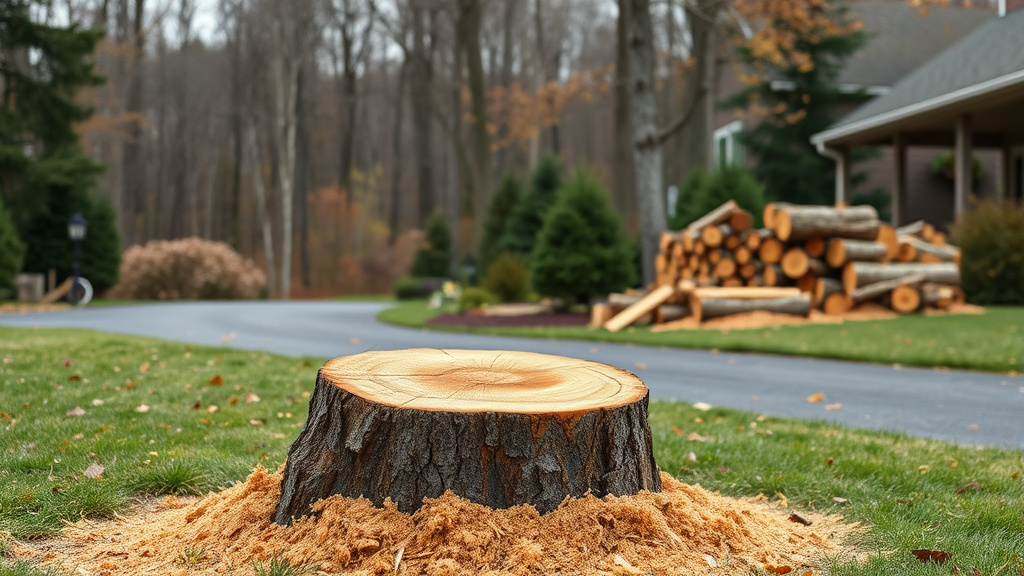
Choice three: grind the stump and reclaim the ground
Grinding takes the stump several inches below grade and turns it into chips, leaving the roots to rot in place. It is the only one of the three choices that disturbs the soil, and that is where Burke's particular conditions come in. The first is utilities: a grinder working below grade is digging, and Virginia 811's guidance is to contact the free locate service three days before any digging project so buried lines can be marked. The second is water. Many Burke lots run down to Pohick Creek or one of its feeder streams, and the strips along them are often a Resource Protection Area or a conservation easement. The county's rule for those strips is that dead, diseased or dying trees can be removed by hand, but replacement with similar vegetation may be required, the restricted area should be described in the recorded deed and may appear on the plat, and anything more than hand removal needs a waiver first.
The third is disposal, and it surprises people every autumn. Fairfax County defines yard waste as material from general yard maintenance, with brush meaning branches and twigs shorter than four feet, and it states that yard waste does not include materials generated during tree removal, land clearing or home renovation. Stumps are named specifically: a stump free of most dirt can be taken to the I-66 Transfer Station or the I-95 Landfill Complex, but it will not be collected at the curb with the leaves. In practice the grinding crew hauls the chips or spreads them, and the owner never has to deal with the stump as an object at all.
Reading the three choices on one lot
A Burke owner with a mature white oak twenty feet from the house usually faces all three choices at once. If the oak is sound and simply too close, a reduction of the limbs over the roof keeps it, and the timing of that work in a region where storms are arriving harder and later is discussed in an article on adjusting trimming to the changing seasons. If the base shows decay, it comes down, and the owner then decides whether the stump stays. If the plan is lawn, a patio or a replacement tree, the stump is ground, and the replacement goes in a few feet to one side so it is not competing with a decaying root plate. The one path to avoid is grinding first and asking questions later, because the utility marks and the easement check have to come before the machine does.
Who makes the call in Burke
G&V Tree Service, a family-owned company based in Springfield since 2001, handles all three jobs across Burke, and the same crew that assesses a tree does the work, because the company does not subcontract. Every crew is led by ISA certified arborists trained to ANSI A300 standards; the company belongs to the Tree Care Industry Association and the International Society of Arboriculture, and it is licensed for tree care in Virginia and insured specifically for tree work. The assessment is done on site, in writing, at no charge, which is the point at which an owner finds out which of the three choices actually applies.
From Burke United Methodist on Burke Centre Parkway to the office
Burke United Methodist Church at 6200 Burke Centre Parkway sits at the heart of Burke Centre; the G&V Tree Service office on Brandon Avenue in Springfield is a short drive east along Old Keene Mill Road, mapped below.
G&V Tree Service Inc · 6434 Brandon Ave, Suite 204, Springfield, VA 22150 · (703) 569-2570
Questions Burke owners ask before deciding
If I remove a tree in the stream buffer, do I have to replace it? Inside a Resource Protection Area the county says replacement with similar vegetation may be required even for a dead tree removed by hand, so ask before cutting.
Will the stump grow back if I just cut the tree? Many species will send up sprouts from the stump and roots for years. Grinding below grade stops the sprouting from the stump itself.